A Guide to Mandatory Thermal Response Testing (TRT) for Schools
If you’re adding low-carbon heating to a new-build or major refurbishment for a school or trust, you should be aware of the latest Department for Education (DfE) Employer’s Requirements (2026).
They directly affect your ground source heat pump (GSHP) strategy.
With the DfE’s targets for reducing carbon emissions, GSHPs have become a priority technology wherever feasible.
But under the latest DfE update, Thermal Response Testing (TRT) is now a mandatory prerequisite for these schemes.
This guide explains:
- What Thermal Response Testing is
- The key DfE requirements to satisfy before choosing a supplier
- Why early specialist help is crucial.
Thermal Response Testing (TRT): A brief overview
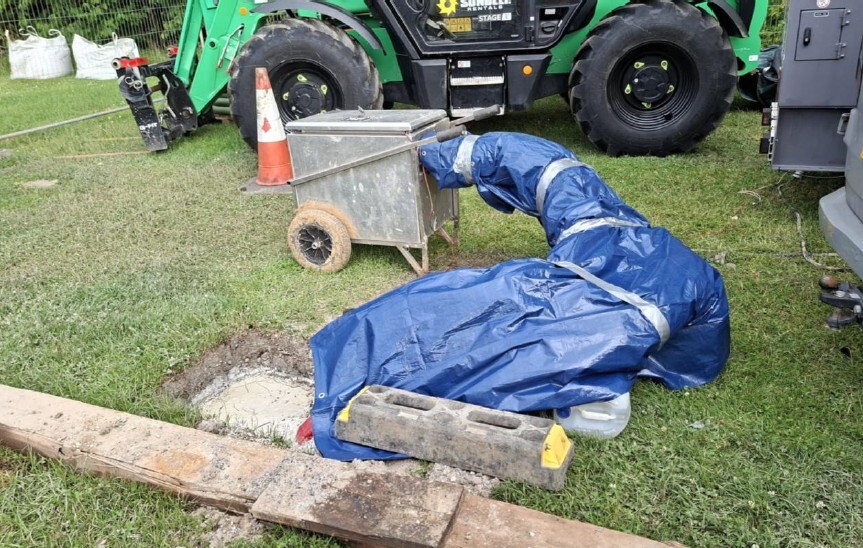
Before installing a closed-loop ground source heat pump system with vertical boreholes, designers must know how efficiently the surrounding earth can absorb and release heat.
The ground’s thermal properties can’t simply be guessed. If they were, it would risk:
- Under-sizing the system: Leaving classrooms cold
- Over-sizing the system: Wasting tens of thousands of pounds on unnecessary drilling.
A Thermal Response Test (TRT) is the simplest and most exact indirect (in-situ) field measurement method for determining the ground’s precise thermal properties.
In other words, it ensures your borehole array is custom-tailored to the exact ground conditions of a school site.
2026 DfE ground source requirements: What you must comply with
The DfE’s January 2026 Employer’s Requirements (including the General Conditions, Technical Manual, and Exchange Information Requirements) and subsequent April 10, 2026 update place strict, legally binding obligations on education projects.
Key requirements for ground source heat pumps (GSHPs) include the following.
TRT is strictly mandatory
For all new school projects utilising a GSHP, thermal response tests shall be used to:
- Confirm dynamic loop modelling assumptions. (Dynamic modeling must also prove the system’s technical feasibility before the heat pump installation process begins)
- Inform the final borehole array design.
Mandatory specialist sourcing
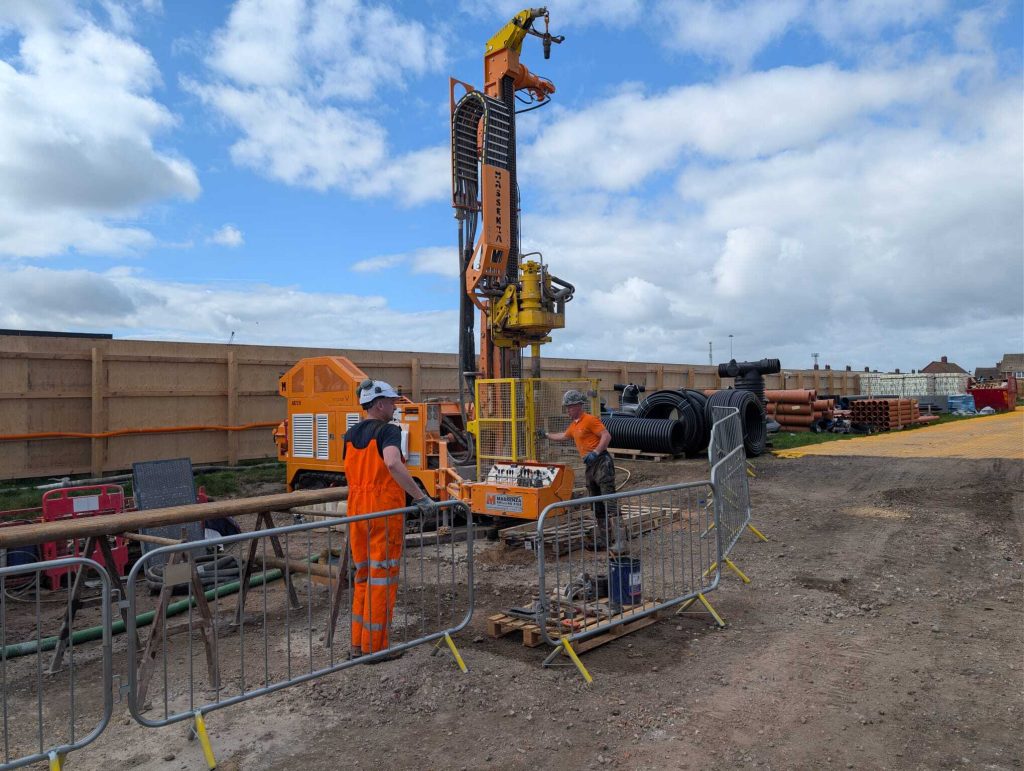
GSHP systems must be designed and installed by a certified ground source heat pump specialist. This includes for:
- The ground loop
- The manifolds (the distribution unit that connects multiple ground loop circuits or boreholes
- The boreholes.
30-year infrastructure promise
The DfE operates under strict minimum life expectancy standards.
Boreholes and underground pipework manifolds represent permanent site infrastructure. They must have a minimum life expectancy of 30 years.
(In comparison, the heat pump plant has a 20-year expectancy. And Air Source Heat Pumps (ASHPs) carry only 15 years.)
A certified, high-quality specialist is essential to guarantee a ground array lasts this long.
Energy Use Intensity (EUI) limits
School buildings must achieve maximum energy consumption limits (excluding on-site renewable generation). The maximum permissible EUIs (in-use energy use) are:
- Primary Schools: 52 kWh/m² per year [96]
- Secondary Schools: 60 kWh/m² per year [96]
- Colleges: 70 kWh/m² per year.
Basing your design on actual TRT data is the only way to ensure it meets these limits.
Low flow temperature heating
Low temperature hot water (LTHW) systems must be designed to operate at a maximum flow temperature of 45°C.
This requirement is aimed at maximising system efficiency (Seasonal Coefficient of Performance, or SCOP).
Peak lop cooling integration
GSHP ground loops must also be utilised to deliver peak lop cooling (e.g., maintaining kitchen temperatures below 28°C or providing environmental cooling in SEND spaces for pupils who cannot thermoregulate).
This further emphasises the need for highly precise thermal modeling.
Why earlier specialist involvement is vital for school budgets
Boreholes are a long-term, high-cost capital asset.
For school building projects under the DfE Construction Framework, the earlier a specialist is involved, the better.
Overall, it means the smoother and more cost-effective the project will be. This can be broken down further into the following three areas:
- Protects the RIBA Stage 1 & 2 planning: Getting the right specialist involved during RIBA Stage 1 (Preparation and Briefing) or RIBA Stage 2 (Concept Design) means the dynamic thermal simulation and ground array layouts are grounded in reality from day one.
- Prevents redundant drilling costs: If ground conductivity is better than generic assumptions, you may need fewer or shallower boreholes. This will save your project thousands in drilling costs. Conversely, if ground conditions are poor, early testing prevents your system from under-performing.
- Ensures seamless information delivery: The DfE requires extensive, structured digital documentation at key milestones (RIBA Stages 3, 4, 5, and 6). All borehole data, heat pump specifications, and testing results must be delivered as structured COBie data to form the “Golden Thread” of building safety and operational asset management. Only an established specialist can manage these complex data requirements.
Why partner with Geowarmth for your school project?
At Geowarmth, we understand both the complex geology of ground source technology and the compliance standards of public sector procurement.
We provide a fully managed, turn-key solution to satisfy your DfE requirements:
- Turn-Key TRT Process: We manage the entire testing sequence. From drilling the test borehole, setting up the precision mobile TRT rig, conducting the continuous 48+ hour logging, to providing professional, accredited ground loop analysis reports.
- DfE-compliant specialist design: Our expert engineering team designs highly efficient ground arrays tailored to meet low-flow temperature requirements (45°C LTHW) and integrated cooling strategies.
- Accredited performance: We ensure full alignment with dynamic simulation modeling, MCS certification, and comprehensive handover documentation. This includes Planned Maintenance Plans and digital asset templates for your DfE Information Management reports.
Don’t let compliance deadlines or inaccurate ground assumptions derail your school project’s budget. Partner with a trusted ground source specialist early in your design process.
Contact us today to discuss your education project and arrange your thermal response test.