The Future Homes Standard: What Builders, Architects & Developers Need to Know

The government has today laid the regulations that will reshape every new home built in England from 2028. Heat pumps are in. Gas boilers are out. Solar PV is now a legal requirement. Here is what it means for your projects and how to get ahead of it.
Today, 24 March 2026, the UK Government laid the regulations for the Future Homes Standard (FHS), a landmark overhaul of building regulations that has been more than a decade in the making.
For anyone working in residential construction, this is the most significant planning and compliance shift in a generation.
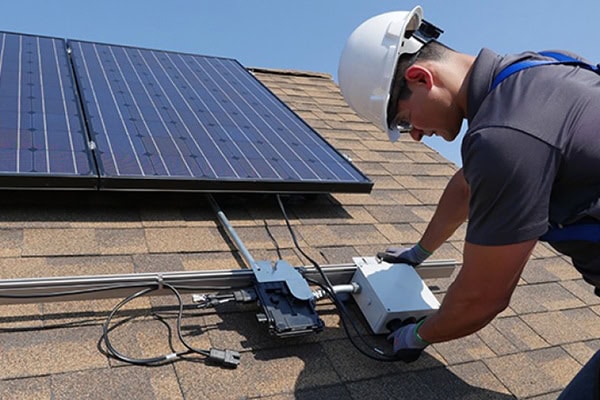
The short version: from March 2028, virtually all new homes built in England must come with solar panels fitted as standard and low-carbon heating, overwhelmingly heat pumps, as the primary heat source. Gas boilers are effectively eliminated from new-build specifications.
At Geowarmth, we have been anticipating and preparing for this moment for years.
We wanted to cut through the noise and give the architects, consultants, housing associations and developers we work with a clear, practical picture of:
- What has changed
- What is coming
- How to make sure your pipeline of projects stays on track.
| 75% Reduction in greenhouse gas emissions vs homes built to 2013 standards |
| £830 Annual energy bill saving for families vs a standard EPC C home |
| 2028 Year FHS compliance becomes mandatory for new builds in England |
What the Future Homes Standard Actually Requires
The FHS amends Part L of the Building Regulations 2010 and introduces a package of requirements for all new dwellings.
Here are the key headlines:
1. Heat pumps become the default heating system
The FHS sets a “notional building” specification, a reference design that all new homes must match in terms of energy performance.
That notional building includes:
- An air source heat pump
- Wastewater heat recovery
- Improved airtightness
- Decentralised mechanical extract ventilation (dMEV).
For mid- and high-rise flats, connection to a low-carbon heat network is the anticipated route to compliance.
Gas boilers are not part of the notional building. Homes built to the FHS will be fully fossil-fuel-free from day one and will require no retrofitting to achieve zero carbon emissions once the electricity grid is fully decarbonised.
2. Solar PV is now a legal functional requirement
This is significant and represents a shift in approach.
Rather than including solar in the notional building specification (which would have required panels covering 40% of ground floor area, potentially impractical on many sites), the government has introduced a new legislative “functional requirement” for on-site renewable electricity generation.
In practice, the vast majority of homes will need solar panels equivalent to at least 40% of their ground floor area.
Where that is genuinely not achievable, due to shading, roof design, or other site constraints, a “reasonable provision” of solar is still required.
High-rise buildings above 18 metres are exempt. The guidance in the updated Approved Documents provides technical diagrams to help designers understand where flexibility exists and where it does not.
| KEY POINT FOR DESIGNERS Solar is no longer optional, a nice-to-have, or purely a way to hit a compliance score. It is a standalone legal requirement sitting outside the energy performance calculation. Every new home specification needs to address it explicitly from the earliest design stage. |
3. Fabric standards are tightened
The FHS requires improved airtightness across all dwelling types, a tightening from current Part L 2021 standards.
Combined with dMEV ventilation and wastewater heat recovery, this means homes will be more thermally comfortable, with less uncontrolled heat loss.
For architects and structural engineers, this has implications for detailing, testing and commissioning requirements.
4. A new Home Energy Model (HEM) replaces SAP
The Standard Assessment Procedure (SAP) is being replaced by the Home Energy Model (HEM). A dual-running period of at least 24 months will allow developers and energy assessors to use either SAP or HEM.
SAP will not be switched off immediately, which is helpful for smaller developers and assessors who need time to retrain and update software.
But the direction of travel is clear: HEM is the future.
The Timeline: When Does This Affect Your Projects?
Today, 24 March 2026
Regulations laid. The FHS statutory instrument is laid in Parliament today. The clock starts on transitional arrangements.
March 2027
Regulations come into force. Developers who submit a full plans application, building notice, or initial notice to the local authority before this date, and commence construction within a further 12 months, can still build to Part L 2021 standards for those specific buildings.
March 2028
Full FHS compliance required. Any development that has not commenced construction by March 2028 must meet the Future Homes Standard in full. From this point, solar PV and heat pumps are mandatory on virtually all new homes.
HRBs: Extended timeline
Buildings over 18 metres or 7+ storeys (and care homes/hospitals) have longer transitional arrangements. Developers have 18 months from today to submit a successful Gateway 2 application, then up to 3 further years to commence construction.
| ACTION REQUIRED: DO NOT ASSUME YOU HAVE TWO YEARS The transitional arrangements apply per individual building, not per site. Developers cannot secure transitional arrangements for an entire development by only progressing a handful of plots. Every building must individually meet the submission and commencement deadlines. If you have live sites or projects in the pipeline, now is the time to review their status. |
What This Means in Practice for Your Projects
The FHS is a performance-based standard, not a prescriptive one.
That is good news for design teams: you do not have to follow the notional building specification to the letter, you just have to match its energy performance.
That gives flexibility in how you get there. But in the vast majority of cases, heat pumps, solar PV, improved insulation, and dMEV ventilation will be the practical route to compliance.
For architects and designers
- Solar panel provision needs to be integrated into roof design from the earliest feasibility stage, not bolted on at planning. Orientation, pitch, shading and structural loading all need consideration.
- Heat pump plant room space (or external unit positioning for ASHPs) needs to be designed in. Unlike a boiler, heat pumps have different spatial requirements and acoustic considerations.
- Improved airtightness targets mean more careful detailing at junctions, particularly around windows, doors, and service penetrations. Commissioning and testing protocols are tightened under the new Approved Documents.
- The new Home User Guide requirements are more detailed, especially around heat pumps and underfloor heating. This needs to be factored into client handover packs.
For developers and housebuilders
- The average additional capital cost per dwelling is estimated at £4,350 above current Part L 2021 standards (ranging from £1,550 for high-rise flats to £5,690 for mid-terraced houses). This needs to factor into appraisals and land bids now.
- Heat pump supply chains and MCS-certified installers need to be confirmed early. The industry is scaling up, but forward planning on procurement is essential given lead times.
- Reviewing your existing planning consents and live site programmes is urgent. Any site where you want transitional protection must have notices submitted before March 2027 and construction commenced by March 2028.
- SME developers get no blanket exemption, the government explicitly ruled this out, but will benefit from the extended SAP/HEM dual-running period and support through the Future Homes Hub.
For housing associations and RSLs
- All new affordable housing and social rented developments must meet the same FHS standards. Maintenance and replacement costs for heat pumps and solar will sit partly with housing associations, making whole-life cost modelling critical.
- Heat pumps in social housing require particular attention to Home User Guide quality and resident education, both of which are addressed in the updated Approved Documents.
- The FHS government analysis estimates significant long-term bill savings for tenants and improved asset quality, making the investment case compelling over a 60-year asset life.
Why This Matters Beyond Compliance
The FHS is not just a box-ticking exercise. The independent impact assessment published alongside today’s regulations projects £11.25 billion in net present social value over 70 years, driven overwhelmingly by carbon savings.
Homes built to the standard are forecast to save families up to £830 per year on energy bills compared to a typical existing home, with some estimates putting savings closer to £1,000 depending on property type and usage patterns.
For developers, there is also an emerging market signal worth noting: energy efficiency premiums are real and growing.
Buyers and renters are increasingly choosing to pay more for homes with demonstrably lower running costs, particularly as energy market volatility continues to drive interest in fossil-fuel independence.
An FHS-compliant home with solar panels and a heat pump is a more marketable product, not just a more compliant one.
For architects and consultants, the FHS signals a permanent shift in what competent residential design looks like.
Heat pump-ready layouts, solar-integrated roof design, and airtightness detailing are no longer specialist knowledge; they are core skills for anyone working in new-build residential.
How Geowarmth Can Help You Deliver FHS-Compliant Projects
We have been installing heat pumps and solar PV across the North East, Yorkshire, Cumbria, and the Scottish Borders for over 20 years.
We work with architects, developers, housing associations and main contractors to specify, design and deliver renewable energy solutions, from single-plot self-builds to multi-phase residential developments.
Heat Pump Design and Installation
Air source, ground source and exhaust air heat pumps, specified to the project, sized correctly, and installed by MCS-certified engineers.
We are Vaillant and NIBE accredited partners with full compliance documentation as standard.
Solar PV Systems and Battery Storage
Rooftop solar designed to meet the FHS functional requirement, from feasibility and shading analysis through to installation, commissioning, and grid connection. Paired with Tesla Powerwall and Enphase battery storage where appropriate.
Early-Stage Design Consultancy
We work with design teams at feasibility and RIBA Stage 1 and 2 to assess solar viability, heat pump options, and plant space requirements, avoiding costly redesigns at later stages.
Developer and Volume Builder Packages
Repeat programmes for housebuilders and housing associations across multiple plots and phases. Coordinated supply, installation and commissioning across your full development pipeline.
Ground Source and Thermal Testing
For sites where ground source heat pumps offer the best route to compliance, we provide thermal needle probe measurement, thermal response testing, and ground loop design services.
What to Do Right Now
If you have live projects or a pipeline of schemes in development, here is a practical checklist:
- Audit your pipeline. Identify which projects will be affected by the FHS and which might qualify for transitional arrangements if notices are submitted before March 2027.
- Engage early on heat pump specification. Do not leave it to the mechanical engineer at Stage 4. Heat pump selection affects plant room layout, external space, acoustic design, and the hot water system specification.
- Commission a solar feasibility assessment. Particularly for sites with complex rooflines, high-rise elements, or potential shading issues. The functional requirement has flexibility, but you need to document why and how.
- Update your cost plan assumptions. The FHS adds an average of £4,350 per dwelling above current Part L 2021 costs. Land appraisals and viability assessments that do not reflect this risk being fundamentally wrong.
- Speak to your energy assessor. Make sure your SAP assessors are across the changes and understand the dual-running arrangements with HEM.• Talk to us. We are ready to support feasibility work, specification reviews, and full installation programmes. The earlier we are involved, the better the outcome.
Ready to Talk About Your Projects?
Whether you are an architect wanting early design input, a developer reviewing your pipeline, or a housing association planning your next programme, we would welcome a conversation.